Food supply chain optimization
We don’t just supply ingredients. We help optimize the operation behind them.
The ingredient changes. The operation changes with it. This is the diagnosis we run with every client: recognize, diagnose, reframe, model, pilot, validate and scale.
03 · Operational diagnosis
The plate is the last step. The cost starts long before.
- 01Source
- 02Transport
- 03Receive
- 04Refrigerate
- 05Store
- 06Inspect
- 07Wash
- 08Sanitize
- 09Peel
- 10Cut
- 11Prep
- 12Portion
- 13Discard
- 14Serve
Select a cost driver to see where it appears in the chain:
The question isn’t what an ingredient costs. It’s what it takes to use it.

The Essence FoodTech solution
Move complexity upstream.
Convert perishability into a format your operation can control. Preparation happens once, upstream, under a defined specification — not every morning in every kitchen.
Fresh operation
- 01Purchase + freight
- 02Receive + inspect
- 03Cold storage + energy
- 04Wash + sanitize
- 05Peel + cut + pulp
- 06Waste + spoilage exposure
The Essence FoodTech
- 01Defined specification
- 02Receive dry, compact
- 03Measure · dose · use
- Reduced cold-chain dependencyfor validated dry formats
- Compact storagesealed, dry, stackable
- Lower transport massvs the equivalent fresh input
- More predictable portioningdosed by weight
- Potentially fewer prep stepsno peel, seed or trim at point of use
- More standardized executionacross locations
- Longer usable shelf lifevaries by product, formulation and packaging
- Formats tailored to applicationslices, pieces, powder
- Less cold-chain pressure
- Faster prep
- More usable shelf life
- Compact storage
- Consistent output
- Simpler execution
- Portion control
- Ready to scale
- From storage to service
- More operational control
11 · Fresh vs The Essence FoodTech
The same plate. A different operation behind it.
Compare steps, cold dependencies, waste exposure and portioning. We only quantify what has validated data behind it.
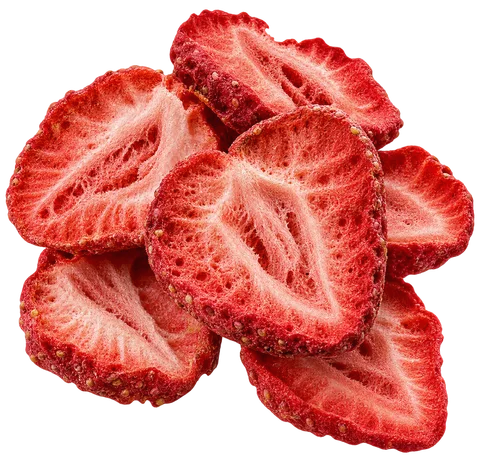 Strawberry
| Same usable output | Fresh | The Essence FoodTech |
|---|---|---|
| Handling steps on site | 7 steps: sort and discard damaged fruit, wash and sanitize, hull, slice or purée, hold refrigerated… | 4–5 steps: measure, (hydrate), mix, finish, serve |
| Mass to buy and move | ≈ 12.50 kg fresh-equivalent input | 1 kg freeze-dried |
| Prep at the point of use | Wash, peel, cut, trim | Measure, dose, use |
| Cold-chain dependency | Refrigerated storage | Reduced — dry format, per spec sheet |
| Waste exposure | Peel, seed, trim, spoilage | No peel or seed on site |
| Portion control | Varies with ripeness and staff | Dosed by weight |
| Storage footprint | Bulky, perishable | Compact, sealed |
| Shelf-life flexibility | Short, ripeness-dependent | Longer usable life, where validated |
| Consistency across sites | Seasonal and variable | Same specification |
Only the mass figure is quantified (from the configured yield). Other factors are qualitative until measured in your pilot.
17 · Commercial journey
You don’t need to change the entire operation at once.
- 01DiagnoseUnderstand the current process.
- 02ModelCompare usable ingredient cost.
- 03PilotTest one application.
- 04ValidateMeasure operational results.
- 05ContractDefine supply conditions.
- 06ScaleExpand across formats or locations.
Start with one ingredient. Prove the difference.
Start with one ingredient17 · Commercial journey
You don’t need to change the entire operation at once.
- 01DiagnoseUnderstand the current process.
- 02ModelCompare usable ingredient cost.
- 03PilotTest one application.
- 04ValidateMeasure operational results.
- 05ContractDefine supply conditions.
- 06ScaleExpand across formats or locations.
Start with one ingredient. Prove the difference.
Start with one ingredient

Start with one ingredient. Prove the difference.
THE ESSENCE FOODTECHFood Supply Optimization